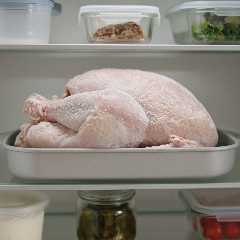

Thanksgiving is Thursday, November 26, 2026. That is eight days from now. If your turkey is in the freezer, the clock on it may have already started.
A frozen turkey does not thaw overnight. The U.S. Department of Agriculture (USDA) says to allow about 24 hours in the refrigerator for every 4 to 5 pounds. A big bird can need five or six days. Count back from Thursday and the start date for a 20 to 24 pound turkey is this Friday, November 20.
This guide gives you the dates, a plan for what to do if you are running late, and the stove rules that keep the day calm. Start with the table.
Step 1. Find your turkey's start date
The safest way to thaw a turkey is in the refrigerator, set at 40°F or below. It is slow, but it keeps the whole bird cold the entire time. Here are USDA's thaw times by weight, and the latest day to put a frozen bird in the fridge to be ready on Thursday, November 26.
| Turkey weight | Fridge thaw (USDA) | Cold-water thaw (USDA) | Latest fridge start for Thursday, Nov. 26 |
|---|---|---|---|
| 4 to 12 lb | 1 to 3 days | 2 to 6 hours | Monday, Nov. 23 |
| 12 to 16 lb | 3 to 4 days | 6 to 8 hours | Sunday, Nov. 22 |
| 16 to 20 lb | 4 to 5 days | 8 to 10 hours | Saturday, Nov. 21 |
| 20 to 24 lb | 5 to 6 days | 10 to 12 hours | Friday, Nov. 20 |
The last column is our own arithmetic, not a USDA table. We took Thursday, November 26 and subtracted the top end of USDA's thaw range for each weight.
A few notes on using it:
- If your bird is right on the line, such as exactly 20 pounds, use the longer row.
- Start a day early if you can. USDA says a turkey thawed in the fridge can stay there for 1 to 2 more days before you cook it. Starting a day early costs you nothing and gives you a cushion. Starting up to about two days earlier than the table says still keeps you inside that window.
- Check your fridge. USDA's times assume 40°F or below. An inexpensive appliance thermometer will tell you what your fridge is really doing. That tip is general kitchen practice, not a figure from the USDA pages.
- Put the bird in a pan or container so the juices cannot drip onto other food.
- Pull the giblets after it thaws and cook them separately.
- Refreezing: USDA says a turkey thawed in the fridge can be refrozen without cooking, though some quality is lost. A turkey thawed in cold water or the microwave has to be cooked right away.
If you are running late
If the table says you should have started yesterday, you still have two safe options.
Cold water. Keep the turkey in its leak-proof wrapping, or put it in a leak-proof bag. Submerge it in cold tap water. Allow about 30 minutes per pound, and change the water every 30 minutes so it stays cold. A 16 pound bird takes about 8 hours. Cook it immediately after it thaws.
Microwave, for a small bird only. USDA gives about 6 minutes per pound, if the turkey fits in your microwave. Cook it right away.
Cook it from frozen. This is safe, too. USDA says to plan for at least 50% longer than a thawed bird takes. Do not use an oven bag. Once the turkey has baked for 20 to 30 minutes, USDA says to remove the giblet packet with tongs. USDA's "SOS on Turkey Day" page (source 6 below) lists cook-from-frozen times by weight, so check it, and the oven temperature, before you set your schedule.
What not to do
Never thaw a turkey on the counter, in the garage, on the back porch, in the trunk of a car, in a brown paper bag or garbage bag, in the dishwasher, or in hot water. USDA explains why. The outside of the bird warms into the "danger zone," which is 40°F to 140°F, where bacteria multiply fast, while the center is still frozen.
Step 2. Your countdown from today to Thursday
Here is the whole week in one list.
| Day | What to do |
|---|---|
| Wednesday, Nov. 18 (today) | Weigh the bird or read the label. Find your start date in the table. Make sure the fridge has room for the turkey and a pan. Press the test button on every smoke alarm. Buy a food thermometer if you do not have one. Find a lid or baking sheet that fits your biggest pan, and check where your fire extinguisher is. |
| Friday, Nov. 20 | Latest start for a 20 to 24 lb frozen turkey. |
| Saturday, Nov. 21 | Latest start for a 16 to 20 lb turkey. |
| Sunday, Nov. 22 | Latest start for a 12 to 16 lb turkey. |
| Monday, Nov. 23 | Latest start for a 4 to 12 lb turkey. |
| Tuesday, Nov. 24 and Wednesday, Nov. 25 | If you are buying fresh, USDA says to buy no earlier than Tuesday or Wednesday unless the label shows a use-by date. Make the sides that keep. Clear towels and wrappers off the counters. Decide who is the stove watcher. |
| Thursday, Nov. 26, morning | Check that the bird is fully thawed. Take out the giblets. Heat the oven. Get the thermometer ready. |
| Thursday, Nov. 26, dinner | Check the temperature, keep hot food hot and cold food cold, and watch the clock. |
| After dinner | Get leftovers into the fridge within 2 hours. |
USDA also suggests planning about 1 pound of turkey per person.
Step 3. Cook it and serve it safely
USDA's Thanksgiving advice from November 13, 2026 comes down to a few rules:
- Cook to 165°F. Check three places with a food thermometer: the thickest part of the breast, the innermost part of the wing, and the innermost part of the thigh.
- Stuffing: USDA says cooking it separately gives the best safety and even doneness. If you do stuff the bird, the center of the stuffing must also reach 165°F. Do not stuff the turkey the night before.
- Two-hour rule: Refrigerate perishable food, prepared food and leftovers within 2 hours. Throw out perishable food that has been out longer than 2 hours.
- Hot and cold: Keep cold food at 40°F or below and hot food at 140°F or above.
- Leftovers: Divide them into small containers. They keep in the fridge for up to 4 days. Reheat them to 165°F. Frozen at 0°F, they stay safe indefinitely, though the quality drops over time.
If you have a question on the day, the USDA Meat and Poultry Hotline is 1-888-674-6854. On Thanksgiving Day it is open from 8 AM to 2 PM Eastern, which is 7 AM to 1 PM Central. You can also chat at ask.usda.gov.
Step 4. Keep the kitchen safe
Thanksgiving is the busiest day of the year for home cooking fires. According to the National Fire Protection Association (NFPA), about 1,139 home cooking fires were reported on Thanksgiving Day in 2024 (an estimate), which is more than three times a normal day. NFPA also reports that cooking equipment was involved in 80% of Thanksgiving fires, based on the 2020 to 2024 annual average.
The leading cause is not exotic. It is unattended cooking. The U.S. Fire Administration (USFA) lists unattended equipment as 37% of the leading factors in home cooking fires that spread beyond the cooking equipment. NFPA says that with several dishes going while you entertain, it gets that much easier to lose sight of what is on the stove or in the oven.
Here is what NFPA, USFA and the Consumer Product Safety Commission (CPSC) recommend:
- Stay in the kitchen while you are frying, sauteing or boiling. If you are roasting, stay home and check on the oven often. Use a timer.
- Keep kids and pets at least 3 feet away from the stove and from wherever hot food is being carried.
- Keep oven mitts, wooden spoons, food wrappers and towels at least 3 feet from anything hot.
- Avoid long, loose sleeves when you cook.
- Keep a lid or baking sheet next to the pan. For a small grease fire, slide the lid on, turn off the burner, and leave the lid on until the pan is cool. Never use water or flour.
- For an oven fire, turn off the heat and keep the door closed.
- Turn pot handles inward or toward the back of the stove.
- Keep hot food and drinks away from the edges of the table and counter.
- Test your smoke alarms. CPSC recommends one on every level, outside sleeping areas, and inside bedrooms.
- Keep a fire extinguisher nearby and know how to use it.
- If a fire grows, get out. NFPA says to close the door behind you, then call 911.
- Do not cook if you are sleepy or have been drinking.
A word on deep-fried turkey
Deep-fried turkey is the riskiest way to cook the bird. NFPA strongly discourages fryers that use cooking oil. It suggests safer options such as an infrared fryer, an air fryer, an electric turkey fryer, or buying a fried turkey from a store or restaurant. CPSC does not ban oil fryers, but it counted more than 200 turkey fryer incidents since 1998 in its 2018 release.
If someone in your family insists on frying, CPSC's tips are:
- Fry outside only, in an open area away from walls, fences and anything overhead. Never in or under a garage, breezeway, carport or porch.
- Use a level, stable surface, and do not move the fryer while it is in use.
- Keep it in full view while the burner is on.
- Thaw the bird completely and dry it. A partly frozen or wet turkey makes hot oil splatter.
- Do not overfill the pot. Follow the manufacturer's oil level. If your fryer has no instructions, CPSC's water trick is to put the turkey in the empty pot, add water until it is covered by about half an inch, then take the bird out and dry it, mark the water level, dump the water, dry the pot completely, and fill with oil only to that mark.
- Lower and raise the turkey slowly.
- If the oil starts to smoke, turn off the gas right away.
- Keep the propane tank at least 2 feet from the burner, positioned so the wind blows heat away from it.
- If a fire starts, call 911. Do not use water.
Your short version
Here is the whole thing in a few lines.
- Find your start date: Fri. Nov. 20 for 20 to 24 lb, Sat. Nov. 21 for 16 to 20 lb, Sun. Nov. 22 for 12 to 16 lb, Mon. Nov. 23 for 4 to 12 lb.
- Thaw in the fridge, in a pan, and start a day early if you can.
- Running late? Use cold water (30 minutes per pound, fresh water every 30 minutes) or cook from frozen (at least 50% longer).
- Cook to 165°F in three spots, and get leftovers cold within 2 hours.
- Stay in the kitchen, keep a lid handy, and keep kids and pets 3 feet from the stove.
None of this is complicated. It just has a deadline, and this year the deadline for a big bird is this weekend.
Sources
- USDA, "The Recipe for a Safe Thanksgiving," November 13, 2026
- USDA FSIS, "Turkey Basics: Safe Thawing"
- USDA FSIS, "Let's Talk Turkey: A Consumer Guide to Safely Roasting a Turkey"
- USDA FSIS, "Happy Thanksgiving" (hotline hours and fresh-turkey buying advice)
- USDA blog, "How to Safely Thaw a Turkey"
- USDA blog, "SOS on Turkey Day: My Turkey Isn't Ready, What Do I Do Now?"
- USDA blog, "Turkey FUNdamentals: Top Questions for Cooking a Turkey"
- foodsafety.gov, Meat and Poultry Roasting Charts
- NFPA, "Thanksgiving is leading day of the year for U.S. home cooking fires," November 12, 2026
- NFPA, Thanksgiving safety tips
- NFPA, Safety with cooking equipment
- U.S. Fire Administration, Cooking Fire Safety
- CPSC, "Put Safety on the Menu," November 19, 2025
- CPSC, "CPSC Issues Safety Tips for Turkey Fryers," 2004
- CPSC, "Stand By Your Pan," 2018